
COURSE 10 OF 12 · summer SEASON
Boundaries as
Devotional Acts:
Protecting Connection
Without Self-
Abandonment
Boundaries as
Devotional Acts:
Protecting Connection
Without Self-
Abandonment
Boundaries as
Devotional Acts:
Protecting Connection
Without Self-
Abandonment
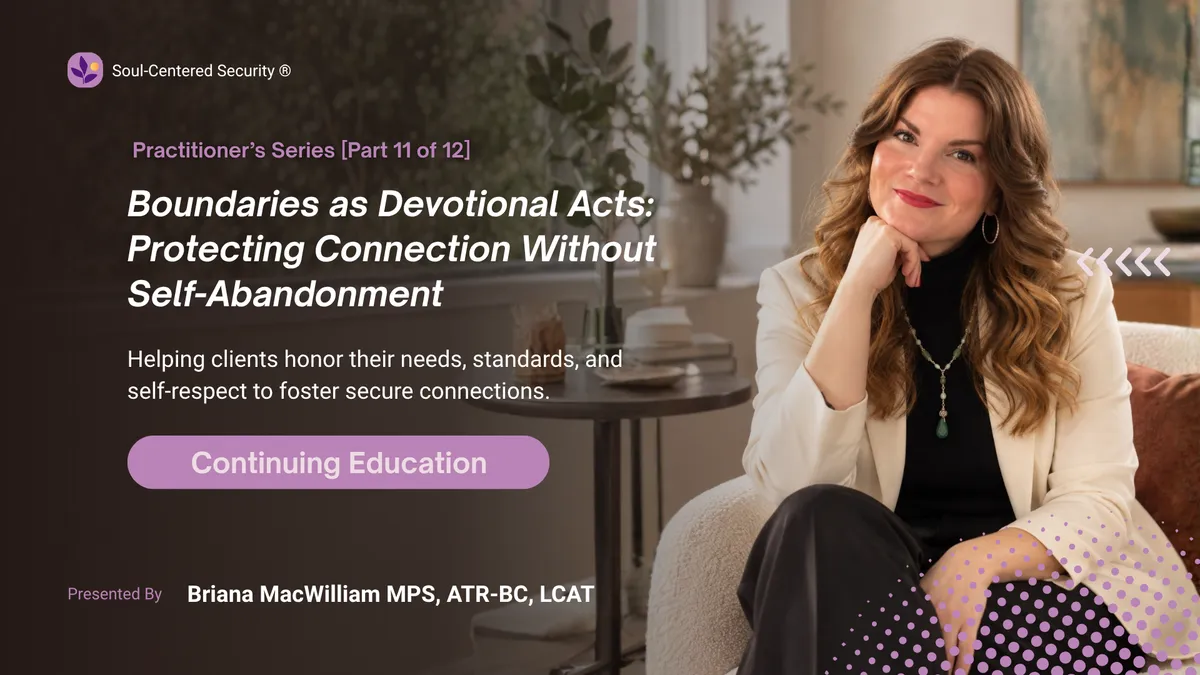
Helping clients honor their needs, standards, and self-respect to foster secure connections.
For clients who confuse being needed with being loved, every boundary can feel like a risk to the relationship. This course gives you experiential tools to help clients set boundaries that are firm without becoming rigid and warm without abandoning themselves.
3.0 CE Contact Hours
(NYS) LCAT + LMHC
Self-Study
About this course
This continuing education course explores healthy boundaries through an attachment- informed, experiential, and expressive arts framework. Participants will examine how insecure attachment can contribute to rigid, diffuse, or inconsistent boundaries; over- responsibility; self-sacrifice; fear of abandonment; and difficulty distinguishing personal needs from another person’s emotional experience.
Clinicians will learn how to help clients identify the emotional needs and values beneath their boundaries, differentiate standards from expectations, and communicate limits using warmth, clear requests, and appropriate consequences rather than control or ultimatums. Through guided imagery, expressive arts body mapping, reflective exercises, and EFT tapping, participants will develop practical interventions for helping clients create boundaries that are firm without becoming rigid, flexible without becoming diffuse, and protective without shutting down authentic connection.
How this course follows the SEED Framework
Across three lectures and an experiential art activities, this course moves through every step of the SEED Framework, so you experience the process yourself before you guide clients through it.

S – Soulful Inquiry
Begins with a boundary confusion self-assessment and the Establishing Healthy Boundaries visualization, centered on a sacred boundary bowl: What do I want and need? How do I want to feel? What am I no longer willing to engage with?

E – Exploration
Explores boundaries as semipermeable membranes, how they become too loose or too rigid, and the emotional needs beneath them. Clients move from an unwanted behavior to the feeling, need, and relational qualities underneath it, then create red and green flag commitments.

E – Expression
Your Boundary Bubble and a Before & After Boundary Body Map across relationships, money, career, and food help clients make the boundary around each value visible and notice where it feels rigid, diffuse, or supportive.

D – Deep Receiving
Clients distinguish standards from expectations, practice the four-part formula of Warmth, Boundary, Request, and Consequence, and use EFT tapping to work through the fear that self-advocacy makes them selfish or “the bad guy.” Care without carrying. Connect without disappearing.
Learning Objectives
By the end of this course, participants will be able to:
OBJECTIVE 1
Identify at least three characteristics of rigid, diffuse, or inconsistent boundaries and describe how they may present in clients with insecure attachment patterns.
OBJECTIVE 2
Differentiate boundaries, emotional needs, standards, expectations, consequences, and
ultimatums when helping clients evaluate interpersonal patterns and relational choices.
OBJECTIVE 3
Apply at least two experiential interventions to help clients clarify boundaries, identify
underlying values and needs, and formulate self-led relational responses that support both
autonomy and connection.
This is for you...
This is for practitioners who…
✓ Work with clients struggling with people-pleasing, over-functioning, rescuing, self-sacrifice, or fear of disappointing others.
✓ Support clients whose boundaries tend to become overly rigid, diffuse, inconsistent, or difficult to articulate.
✓ Want practical ways to help clients distinguish self-protection from controlling another person.
✓Are interested in integrating attachment theory with somatic awareness, expressive arts, guided imagery, and EFT.
✓ Want to help clients communicate needs and standards more clearly without sacrificing warmth, flexibility, or relational connection.
This will help your clients…
✓ Recognize when empathy has shifted into over-responsibility, rescuing, or carrying another person’s emotions.
✓ Identify the deeper emotional needs, preferences, values, and priorities that their boundaries are designed to protect.
✓ Develop boundaries that are firm enough to support self-respect while remaining flexible enough for intimacy and mutuality.
✓ Distinguish between hoping another person will behave
differently and making self-led choices based on personal
standards.
✓ Communicate boundaries with greater warmth and clarity while tolerating the guilt, fear, or discomfort that may arise when they stop abandoning themselves to preserve connection.
Tools to use in practice
A self-assessment, based on the lesson topics
Guided visualization and expressive arts exercise
A story-based scripted EFT Tapping Practice
Downloadable guidebook and lesson summaries
TESTIMONIALS
What practitioners are saying...
"Invigorates my practice."
"As a Licensed Mental Health Counselor with over a decade of experience, finding continuing education that not only meets my licensure requirements but also invigorates my practice is rare. The courses offered by Briana’s continuing education school have been so helpful. Her psycho-spiritual approach deeply resonates with my work, and I've been able to integrate the concepts into therapy with profound results."
- Lena M. LMHC

"A rich tapestry of insight."
"As an art therapist, I'm always seeking ways to deepen my skill set and offer more to my clients. The workshops and seminars at Briana's school are exceptional; each course is a rich tapestry of insight, practical skill-building, and transformative knowledge."
-Michelle C. LCAT
"Fills a gap in the field."
"Holding licenses in both clinical social work and art therapy, I find Briana's continuing education offerings to be unparalleled in their depth and relevance. Her unique blend of traditional psychotherapy with spiritual and creative modalities fills a gap in our field."
- Patricia M. LCSW, LCAT
ENROLLMENT
Choose Your Plan
SINGLE COURSE
$97
Boundaries as
Devotional Acts:
3 Contact Hours for LCATs and LMHCs in New York State
Self-Study

NO REFUNDS
BEST VALUE
THE SUMMER SEASON
$194
Courses 1, 2 & 3 · buy two, get one free
9 Contact Hours for LCATs and LMHCs in New York State
Self-Study
NO REFUNDS
About your instructor

My name is Briana MacWilliam, and I’m a Licensed Creative Arts Therapist (LCAT), Board Certified Registered Art Therapist (ATR-BC), educator, and the founder of Soul-Centered Security®.
I didn’t come to this work because my own relationships were easy. Divorce, grief, and heartbreak brought me face to face with the same attachment patterns I was helping my clients understand. What helped was building a deeper relationship with my body, emotions, creativity, and spirituality.
Over the last 20 years, I’ve served more than 6,000 clients and students across inpatient psychiatry, community mental health, higher education, and private practice. My work weaves together attachment theory, creative arts therapy, embodied practice, and spiritual growth.
I also have additional training in trauma-informed somatic therapy, Internal Family Systems (IFS), hypnotherapy, and ketamine-assisted psychotherapy. And I am the author of Secure in the Spark: A Spiritual Path to Heal Attachment Wounds, available on Amazon and at Barnes & Noble.
My courses for practitioners share the tools and creative processes that supported my own growth, and the healing of the people I’ve had the privilege of serving.
Frequently asked questions
Do I have to take the 12-part courses in order? No. Each course stands alone and is designed to be entered at any point. That said, we recommend starting with Course 1 if you're new.
How will I receive my certificate? After completing your course work, there will be a learning evaluation, instructor evaluation, and webform to complete. After submitting your webform, your certificate will automatically be emailed to you.
How long will I have access to the course? Your purchase includes lifetime access, including to any updates we might make in the future. If a course is retired in the future, we will email you the digital files to download to your own device.
Which boards approve these courses? Briana MacWilliam, Inc. is recognized by the New York State Education Department's State Board for Mental Health Practitioners as an approved provider of continuing education for licensed creative arts therapists (#CAT-0014) and licensed mental health counselors (#MHC-0224). The ATCB has also accepted our courses in the past, because of our state approval, however, we recommend contacting the ATCB directly if you have a concern.
What if I have further questions? You can contact us at [email protected].
Start where your clients are stuck.
PROVIDER INFORMATION
Briana MacWilliam, Inc. is recognized by the New York State Education Department’s State Board for Mental Health Practitioners as an approved provider of continuing education for licensed creative arts therapists; #CAT-0014, and is also an approved provider of continuing education for licensed mental health counselors; #MHC-0224.
PLEASE NOTE:
While some subject areas overlap in education, a course that includes art therapy directives does not qualify a counselor to practice art therapy, and similarly an art therapist is not qualified to practice as a counselor, without proper licensing.
Your Paragraph text goes Lorem ipsum dolor sit amet, consectetur adipisicing elit. Autem dolore, alias, numquam enim ab voluptate id quam harum ducimus cupiditate similique quisquam et deserunt, recusandae. here